

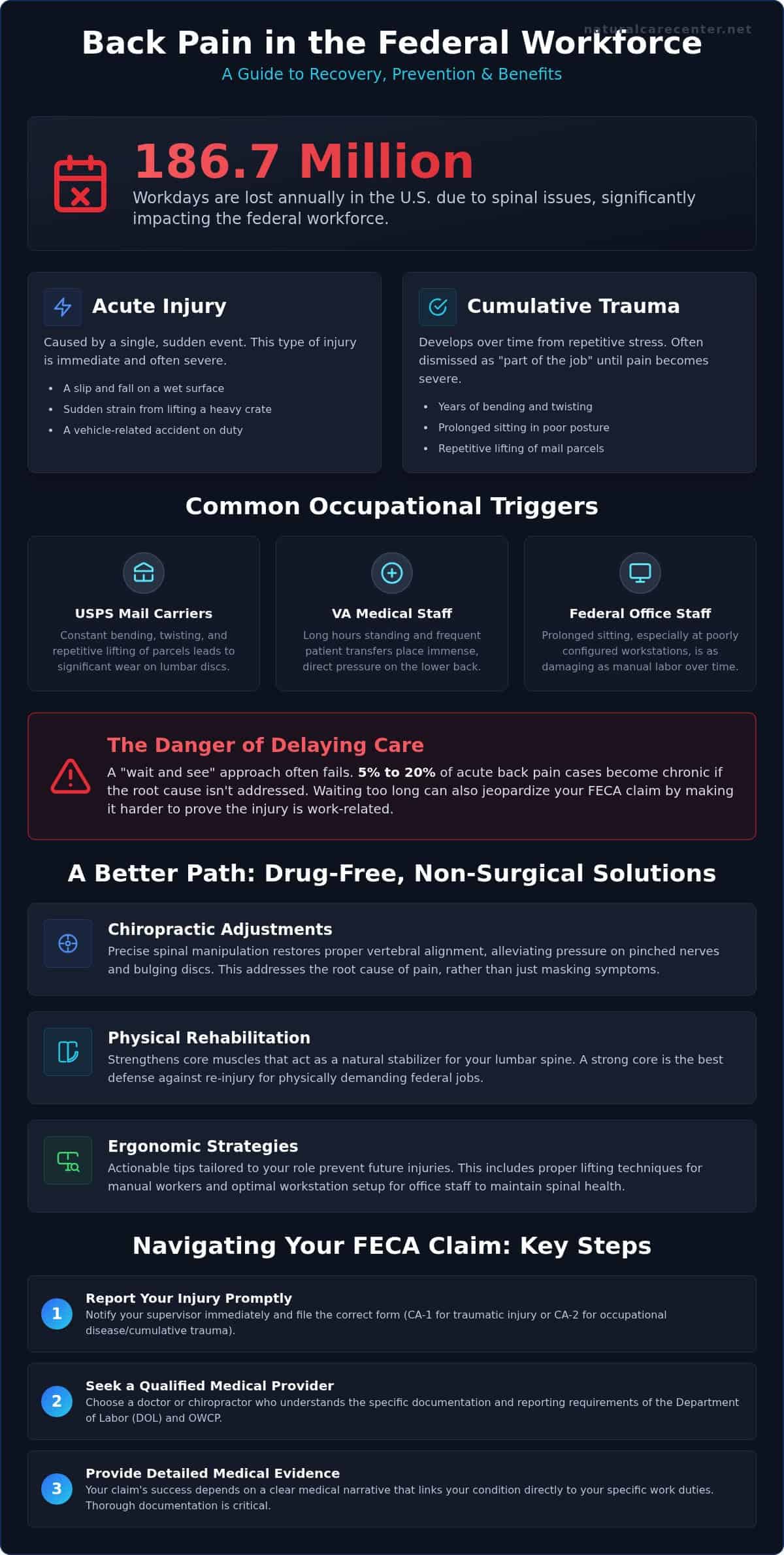
Nearly 186.7 million workdays are lost every year because of spinal issues, and for those in the federal workforce, the stakes are even higher. Whether you’re a postal carrier lifting heavy parcels or an office worker sitting through long shifts, managing lower back pain as a federal employee often feels like a second full-time job. You shouldn’t have to choose between your physical health and your career longevity. We understand the physical toll of your service and the stress that comes with seeking help.
It’s exhausting to deal with sharp, shooting pains while simultaneously worrying if the Office of Workers’ Compensation Programs (OWCP) will approve your care. You might fear that non-invasive options like chiropractic care will be rejected, or that the FECA paperwork is too complex to handle alone. This guide promises to clear the path forward. You’ll discover how to access holistic, surgery-free treatments and successfully navigate the claims process to help you return to full duty without pain. We’ll explore the latest 2026 FEHB coverage details, effective pain management strategies, and the exact steps to filing a claim that puts your health first.
Key Takeaways
- Identify how cumulative trauma from repetitive lifting and long shifts impacts your spine differently than a sudden traumatic accident.
- Explore drug-free, non-surgical solutions like chiropractic adjustments to restore your health without the risks of opioids or invasive procedures.
- Learn how to navigate complex FECA paperwork and find a qualified provider who understands specific DOL requirements for your claim.
- Master the clinical and administrative steps for managing lower back pain as a federal employee to ensure both your recovery and your benefits are protected.
- Gain actionable ergonomic tips tailored for postal carriers and office staff to prevent future injuries and maintain peak physical performance.
Understanding Lower Back Pain in the Federal Workforce
Lower back pain is one of the most common ailments affecting the American workforce. Data from the Department of Veterans Affairs suggests that as many as 9 out of 10 people will struggle with this condition at some point in their lives. For federal workers, this isn’t just a statistic; it’s a daily reality that can threaten your livelihood. Whether you’re experiencing a dull ache or a sharp, debilitating sensation, it’s vital to recognize that this is a legitimate workplace injury. You can find a comprehensive overview of low back pain to better understand the anatomical causes, but for federal employees, the context is often unique to your specific duties.
Successfully managing lower back pain as a federal employee requires understanding how your injury occurred. Federal workers typically face two types of injuries: acute and cumulative. An acute injury happens in a single moment, like a slip on a wet floor or a sudden strain while lifting a heavy crate. Cumulative trauma, however, is the result of repetitive stress over weeks, months, or years. Both are covered under federal regulations, yet cumulative cases are often dismissed by employees as “just part of the job” until the damage becomes severe.
Common Occupational Triggers for Federal Workers
Your specific role within the government dictates the type of stress placed on your spine. Different agencies present distinct challenges:
- USPS Mail Sorting and Delivery: Constant bending, twisting, and repetitive lifting of heavy parcels create significant wear on the lumbar discs.
- VA Medical Staff: Nurses and technicians spend long hours standing and must frequently assist in patient transfers, which places immense pressure on the lower back.
- Federal Office Environments: High-stress administrative roles often involve poorly configured workstations. Without proper ergonomics, sitting for eight hours a day can be just as damaging as manual labor.
Why Traditional ‘Wait and See’ Approaches Fail
Many employees hope that a few days of rest and some over-the-counter pills will solve the problem. Unfortunately, this “wait and see” mindset often backfires. Statistics show that 5% to 20% of acute back pain cases eventually transition into chronic, long-term conditions if the root cause isn’t addressed. Masking symptoms with medication doesn’t fix a misaligned spine; it only delays the necessary care while the injury worsens.
Early intervention is also a critical component of managing lower back pain as a federal employee from an administrative standpoint. The Federal Employees’ Compensation Act (FECA) has strict requirements regarding the timing of medical evidence. Waiting too long to seek professional care can make it much harder to prove that your condition is work-related, potentially jeopardizing your claim and your access to benefits.
Non-Invasive Treatment Options for Federal Employees
Managing lower back pain as a federal employee shouldn’t mean relying on a medicine cabinet full of painkillers or facing the uncertainty of surgery. Traditional medical models often focus on masking symptoms, but our clinic prioritizes a holistic, biological healing process. We believe in drug-free, non-surgical solutions that address the root cause of your discomfort. By focusing on the body’s natural ability to repair itself, we help you achieve long-term physical liberation rather than temporary relief.
Physical rehabilitation is a cornerstone of this approach. We work with you to strengthen your core muscles, which act as a natural stabilizer for the lumbar spine. A strong core is your best defense against reinjury, especially if your job involves the physical demands of mail delivery or patient care. While clinical care is essential, maintaining Proper Office Ergonomics at your workstation also plays a significant role in protecting your back during long shifts. If you’re looking for a personalized path to recovery, our team can help you design a plan that fits your specific occupational needs.
The Role of Chiropractic Adjustments
Spinal alignment is often disrupted by the repetitive motions common in federal service. When vertebrae shift out of place, they can cause bulging discs or pinched nerves, leading to radiating pain and limited mobility. Precise chiropractic adjustments restore proper alignment and alleviate pressure on the nervous system. This form of spinal manipulation is both safe and highly effective for federal workers who need to stay active. Unlike pharmaceutical interventions, adjustments focus on the restoration of health. We don’t just want you to feel better; we want your body to function at its highest potential.
Advanced Relief with Shockwave Therapy
For those struggling with chronic tissue damage that hasn’t responded to standard care, shockwave therapy offers a modern solution for deep tissue repair. This technology uses acoustic waves to create micro-trauma in the affected area, which sounds counterintuitive, but it actually stimulates the body’s natural healing response. It increases blood flow and triggers the repair of deep muscle injuries and stubborn scar tissue. This is particularly beneficial for managing lower back pain as a federal employee when the injury has become chronic over years of service. You can learn more about this innovative treatment in our ultimate guide to shockwave therapy, which details how we use this non-invasive tool to accelerate your recovery.
Navigating OWCP and FECA for Back Injury Claims
The administrative burden of a workplace injury can often feel as heavy as the physical pain itself. The Federal Employees’ Compensation Act (FECA) exists to protect you, providing for medical care and lost wages when you’re hurt on the job. However, the path to receiving these benefits is paved with complex regulations and strict deadlines. Successfully managing lower back pain as a federal employee requires more than just a clinical solution; it requires a provider who understands how to navigate the Department of Labor (DOL) system. Many claims are denied not because the injury isn’t real, but because the medical documentation fails to meet specific OWCP standards.
The biggest hurdle most workers face is finding a federal workers compensation doctor who is experienced in the DOL-OWCP network. Most general practitioners simply aren’t trained in the specialized administrative lexicon required to get a claim approved. Our clinic bridges this gap by providing professional medical care alongside free assistance with your FECA paperwork. We help you accurately complete CA-1 forms for traumatic injuries or CA-2 forms for occupational diseases, ensuring your voice is heard by the claims examiners.
Steps to Filing a Successful Federal Back Injury Claim
Timing and choice are your two most powerful tools when filing a claim. If you’ve suffered a traumatic injury, such as a sudden strain while lifting, you must report it to your supervisor immediately. The 30-day window for filing a CA-1 is vital for maintaining your eligibility for Continuation of Pay (COP). Beyond deadlines, you must remember that you have the legal right under FECA to select your own treating physician. You are not required to see the “company doctor” recommended by your agency. Choosing a specialist who understands that every treatment must be “medically indicated” is the best way to ensure the DOL approves and pays for your recovery process.
Overcoming Common OWCP Obstacles
It’s common for an employing agency to “controvert” or challenge a claim, especially in cases of cumulative trauma where there wasn’t a single, visible accident. When this happens, the quality of your medical evidence becomes the deciding factor. We focus on providing highly detailed “Narrative Reports” that clearly establish a causal relationship between your federal duties and your spinal condition. This level of clinical detail makes it much harder for claims to be dismissed. By choosing a provider with deep expertise in managing lower back pain as a federal employee, you gain an advocate who knows how to fight through the red tape and secure the non-invasive care you deserve.
Daily Management Strategies for the Federal Workplace
When you’re working an 8 to 10 hour shift, your spine is under constant pressure. Proactive habits are essential for managing lower back pain as a federal employee, especially when your duties involve repetitive physical stress. Beyond physical adjustments, the VA Whole Health program emphasizes the “Power of the Mind.” Practicing mindfulness or brief breathing exercises during your shift can lower cortisol levels, which helps reduce muscle tension and systemic inflammation. Incorporating “micro-breaks” every 30 to 60 minutes allows your lumbar discs to decompress, preventing the stiffness that often leads to acute injury.
Ergonomics for Field and Office Workers
Postal carriers and field agents face unique challenges that generic health tips often ignore. If you’re a USPS worker, always use proper lifting techniques for heavy mail bins; bend at your knees and keep the load close to your center of gravity. For those on delivery routes walking 5 or more miles a day, your footwear is your first line of defense. Invest in high quality, supportive shoes with shock absorbing soles to protect your lower back from the impact of hard pavement. If you’re struggling to stay active on the job, schedule a consultation with our federal injury specialists to evaluate your movement patterns.
Federal administrative professionals should audit their workstations to prevent cumulative trauma. A back-safe federal office setup includes:
- Monitor Placement: Keep the top of your screen at eye level to prevent neck strain that travels down the spine.
- Chair Height: Adjust your seat so your feet rest flat on the floor with your knees at a 90 degree angle.
- Lumbar Support: Use a chair that maintains the natural inward curve of your lower back.
- Keyboard Position: Keep your elbows close to your body and your wrists neutral while typing.
At-Home Maintenance and Stretching
Recovery doesn’t end when you clock out. Daily stretches like the “low-back cobra” or “back flexion” can provide immediate relief by gently lengthening the spinal muscles. When managing lower back pain as a federal employee at home, it’s vital to know when to use temperature therapy. Use ice for subacute pain or new flare-ups to reduce swelling. Switch to heat for chronic, dull aches to increase blood flow and relax tight tissues. Additionally, maintaining a healthy weight through a pharmaceutical-free approach reduces the literal load your spine must carry every day. For those seeking professional support, Nusbaum Medical Centers provides doctor-supervised weight management programs that can help reduce this physical stress, helping you return to full duty with less effort and more comfort.
Managing lower back pain as a federal employee is a distinct challenge that requires a specialized solution. It’s not enough to find a doctor who can treat a bulging disc; you need a partner who understands the high stakes of your federal career. Chiropractic Natural Care Center provides a centralized service model where medical expertise and administrative advocacy meet. We believe your path to physical liberation should be as smooth as possible, which is why we handle the complex paperwork while you focus on healing.
Our dual locations in Fort Lauderdale and Lauderhill serve as hubs for South Florida’s federal workforce. We’ve designed our practice to be a solution-oriented environment where the restoration of health is our primary goal. By combining chiropractic adjustments, physical rehabilitation, and advanced shockwave therapy, we ensure your recovery is biological and long-lasting.
Our Expertise in Federal Workplace Injuries
We have spent years cultivating a deep understanding of the niche regulatory frameworks that govern your benefits. Our team includes DOL-OWCP injury specialists who are intimately familiar with the requirements for successful claims. We’ve received genuine gratitude from local federal employees, including postal carriers, VA medical staff, and TSA agents, who have successfully returned to work after receiving our care.
We understand that the OWCP requires specific, detailed evidence. We’re committed to providing medically indicated care that satisfies federal guidelines, backed by the thorough narrative reports needed to protect your claim. We act as your advocate against the red tape, ensuring your injury is treated with the medical authority it deserves.
Get Started on Your Recovery Journey Today
If you’re tired of living with chronic pain or feeling overwhelmed by FECA paperwork, it’s time to take the first step toward relief. We invite you to experience our caring, reassuring, and professional environment. Our goal is to guide you from the initial distress of an injury to the final goal of returning to full duty without pain.
You don’t have to choose between your health and your career. Managing lower back pain as a federal employee is possible when you have a competent and compassionate team by your side. Contact us today to schedule your consultation and discover how our specialized approach can help you reclaim your life and your livelihood.
Your Path to Pain-Free Federal Service
You’ve dedicated your career to serving the public; now it’s time to prioritize your own well-being. Successfully managing lower back pain as a federal employee requires a specialized approach that addresses both your physical recovery and the administrative complexities of an OWCP claim. By choosing non-invasive treatments like chiropractic care and physical rehabilitation, you can achieve physical liberation without the risks of surgery or prescription painkillers. This dual focus on clinical excellence and administrative accuracy ensures you don’t just feel better, but your rights are also protected.
At Chiropractic Natural Care Center, we provide a centralized service model designed specifically for government professionals. Our team offers specialized chiropractic care and free assistance with your OWCP/FECA claims to ensure your documentation meets strict DOL guidelines. With convenient South Florida locations in Lauderhill and Fort Lauderdale, professional help is always within reach. Don’t let chronic pain dictate your future or jeopardize your hard-earned benefits. Schedule Your Federal Injury Consultation Today and take the first step toward a full, pain-free return to duty. You have the strength to recover, and we have the expertise to guide you there.
Frequently Asked Questions
Can I see a chiropractor for a federal workers’ comp claim?
Yes, you can see a chiropractor for a work-related injury. The Federal Employees’ Compensation Act (FECA) recognizes chiropractic care as a valid treatment. However, the Department of Labor has specific requirements for reimbursement. Your chiropractor must provide a diagnosis of a spinal subluxation, which must be demonstrated by an x-ray. Our specialists understand these DOL requirements and ensure your treatment is medically indicated to protect your claim’s validity.
What is the difference between a traumatic injury and an occupational disease claim for back pain?
A traumatic injury occurs during a single work shift, such as a sudden strain while lifting a heavy mail bin. An occupational disease claim involves a condition produced by the work environment over a period longer than one workday. This often includes cumulative trauma from repetitive motions or poor ergonomics. Identifying the correct category is essential for managing lower back pain as a federal employee and ensures you file the proper paperwork.
Does OWCP pay for shockwave therapy or chiropractic adjustments?
OWCP typically pays for medically indicated treatments including chiropractic adjustments and physical rehabilitation. While coverage for advanced tools like shockwave therapy depends on the specific details of your authorized claim, our team works directly with claims examiners to justify necessary care. We focus on non-invasive solutions that promote biological healing. This ensures you receive the highest standard of care without out-of-pocket costs for approved, work-related conditions.
What should I do if my federal agency denies my back injury claim?
If your agency challenges or “controverts” your claim, don’t lose hope. The final decision rests with the OWCP, not your supervisor. You should immediately seek a detailed narrative report from a specialized federal workers’ comp doctor. This report must clearly link your back pain to your specific job duties. We provide free assistance with these administrative hurdles to help you present a strong, evidence-based case to the Department of Labor.
How do I find an OWCP-authorized doctor in Fort Lauderdale or Lauderhill?
You can find authorized care at our Chiropractic Natural Care Center locations in Fort Lauderdale and Lauderhill. We specialize in the unique needs of federal professional groups and are registered within the DOL-OWCP network. Our clinics are conveniently located to serve South Florida’s federal hubs. We provide a centralized service model where you can receive both expert clinical treatment and the administrative support necessary for a successful workers’ compensation claim.
Will I lose my federal benefits if I seek chiropractic care for my lower back?
No, you won’t lose your benefits. FECA explicitly grants you the right to choose your own treating physician, including a chiropractor. Seeking non-invasive care is often the best way to return to full duty quickly. In fact, professional treatment for managing lower back pain as a federal employee can strengthen your claim by providing documented medical evidence of your injury and your commitment to a successful recovery.
What forms do I need to file for a work-related back injury (CA-1 vs. CA-2)?
The form you need depends on how your injury occurred. Use Form CA-1 if you suffered a traumatic injury during a single shift. If your back pain developed gradually over more than one day due to repetitive duties, you must file Form CA-2 for an occupational disease. We offer free assistance to help you determine which form is appropriate and ensure every section is completed accurately to avoid common processing delays.
How long do I have to report a lower back injury to my federal supervisor?
You should report any workplace injury to your supervisor as soon as possible. For traumatic injuries, you must file Form CA-1 within 30 days to remain eligible for Continuation of Pay (COP). For occupational diseases, you have up to three years, but waiting can make the claim harder to prove. We recommend immediate reporting and seeking medical evaluation within the first few days to ensure your injury is documented while the evidence is fresh.